EMAIL
BESPOKE INQUIRY
pureasanaofficial@gmail.com
Explore Articles by Topic:
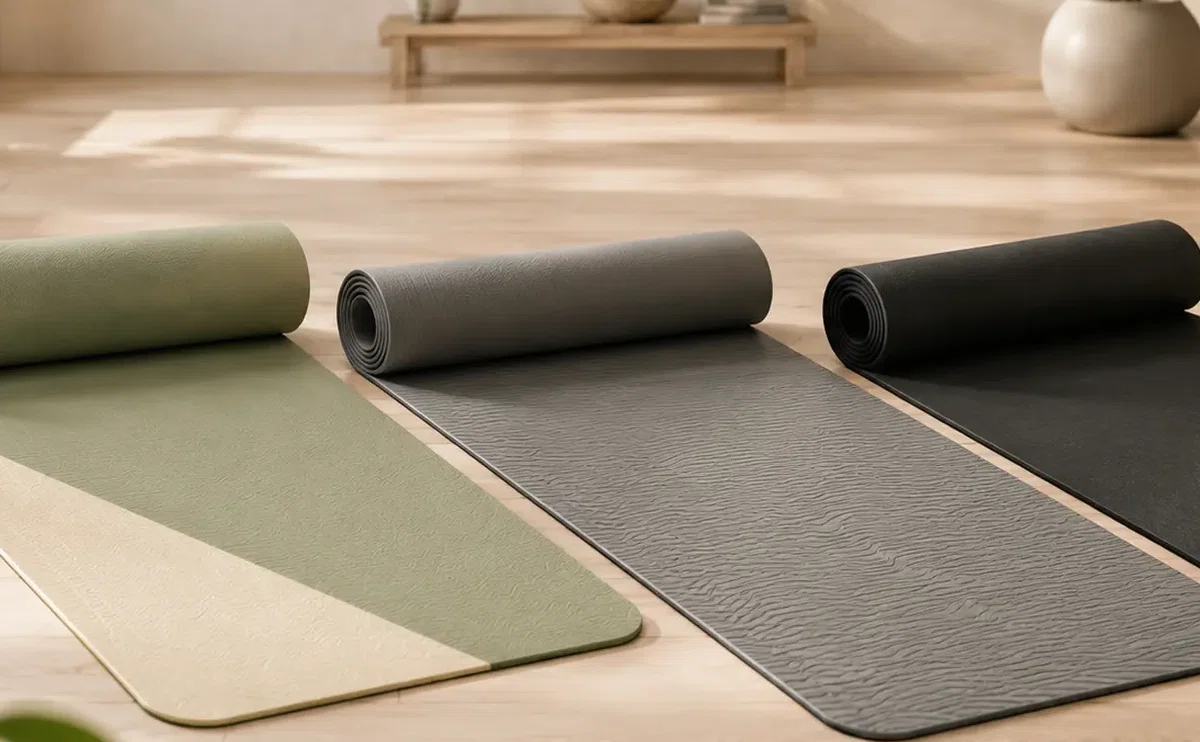
Choosing a yoga mat material affects grip, cushioning, durability, weight, cleaning, product cost, customization, and shipping. For brands and wholesale buyers, the comparison between TPE vs PVC vs natural rubber yoga mats should therefore consider both user experience and commercial requirements.
TPE is generally suitable for lightweight mainstream mats. PVC is commonly chosen for durable and cost-sensitive product lines, while natural rubber is often preferred for stronger floor grip and premium positioning.
No material is automatically best in every situation. The right choice depends on the target customer, selling channel, expected retail price, required performance, product weight, branding method, and packaging.
Effective yoga mat quality control compares finished products with the approved sample and specification sheet rather than checking only one unit. The exact inspection points depend on the material, product structure, logo method, packaging format, and destination market. Buyers should review multiple samples across different cartons because one passing mat does not confirm consistency across the full bulk order.
|
Comparison Factor |
TPE |
PVC |
Natural Rubber |
|---|---|---|---|
|
Surface grip |
Good for general dry practice |
Varies by texture and formulation |
Depends on the upper surface |
|
Floor grip |
Good |
Moderate to good |
Generally strong |
|
Cushioning |
Soft and resilient |
Adjustable by density |
Dense and stable |
|
Durability |
Moderate |
Generally high |
Moderate to high with proper care |
|
Weight |
Lightweight |
Light to medium |
Relatively heavy |
|
Initial odor |
Usually mild |
May be noticeable |
Natural rubber smell may be noticeable |
These are general tendencies rather than fixed guarantees. Performance can change with formulation, density, foaming consistency, thickness, surface treatment, layer bonding, storage, and production control. This yoga mat material comparison is most useful when the samples have similar sizes, densities, thicknesses, and surface structures.
TPE stands for thermoplastic elastomer, a category of materials that combines rubber-like flexibility with the processing characteristics of thermoplastics. In yoga mat manufacturing, TPE is commonly used to produce lightweight foamed mats with dual-layer, two-color, or dual-texture structures.
TPE yoga mats are generally lightweight, soft, and resilient. They are easy to carry and can be produced in a wide range of colors, surface textures, thicknesses, and layered designs.
The soft cushioning and relatively low product weight make TPE suitable for home practice, beginner-friendly collections, mainstream yoga brands, and e-commerce retailers. Two-color and dual-texture constructions also give private-label buyers more flexibility in product appearance and positioning.
Typical characteristics include:
The durability and grip of TPE yoga mats can vary depending on the formulation, density, foaming quality, and surface texture.
TPE may be more sensitive to prolonged heat, direct sunlight, sharp objects, and heavy abrasion than some PVC products. Standard closed-cell TPE surfaces may also provide inconsistent wet grip during sweat-intensive practice.
Wholesale buyers should evaluate density, tear resistance, rebound, surface grip, edge finishing, and roll-flat performance before approving production.
Explore available options for custom TPE yoga mats.
PVC stands for polyvinyl chloride. In yoga mat production, PVC is commonly foamed and embossed to create the required thickness, cushioning, surface texture, and slip resistance.
PVC is one of the most established yoga mat materials and can support a broad range of specifications, from entry-level promotional mats to denser and more durable retail products.
PVC yoga mats are generally durable, moisture-resistant, and easy to clean. Manufacturers can adjust the thickness, density, color, texture, and cushioning according to the intended market and product positioning.
PVC is often selected for schools, fitness centers, promotional projects, beginner product lines, and high-volume wholesale orders.
Typical characteristics include:
PVC products may have an initial material odor after sealed storage. Their environmental positioning is also generally less attractive to brands that emphasize natural-material or sustainability-focused messaging.
However, PVC does not automatically mean low quality. Product performance depends on the formulation, plasticizer selection, density, foaming consistency, surface treatment, and quality control.
Lower-quality PVC mats may stretch, retain pressure marks, curl, deform, or have uneven surfaces. Buyers should therefore evaluate the actual sample and confirm any required restricted-substance testing for the destination market.
Review possible specifications for custom PVC yoga mats.
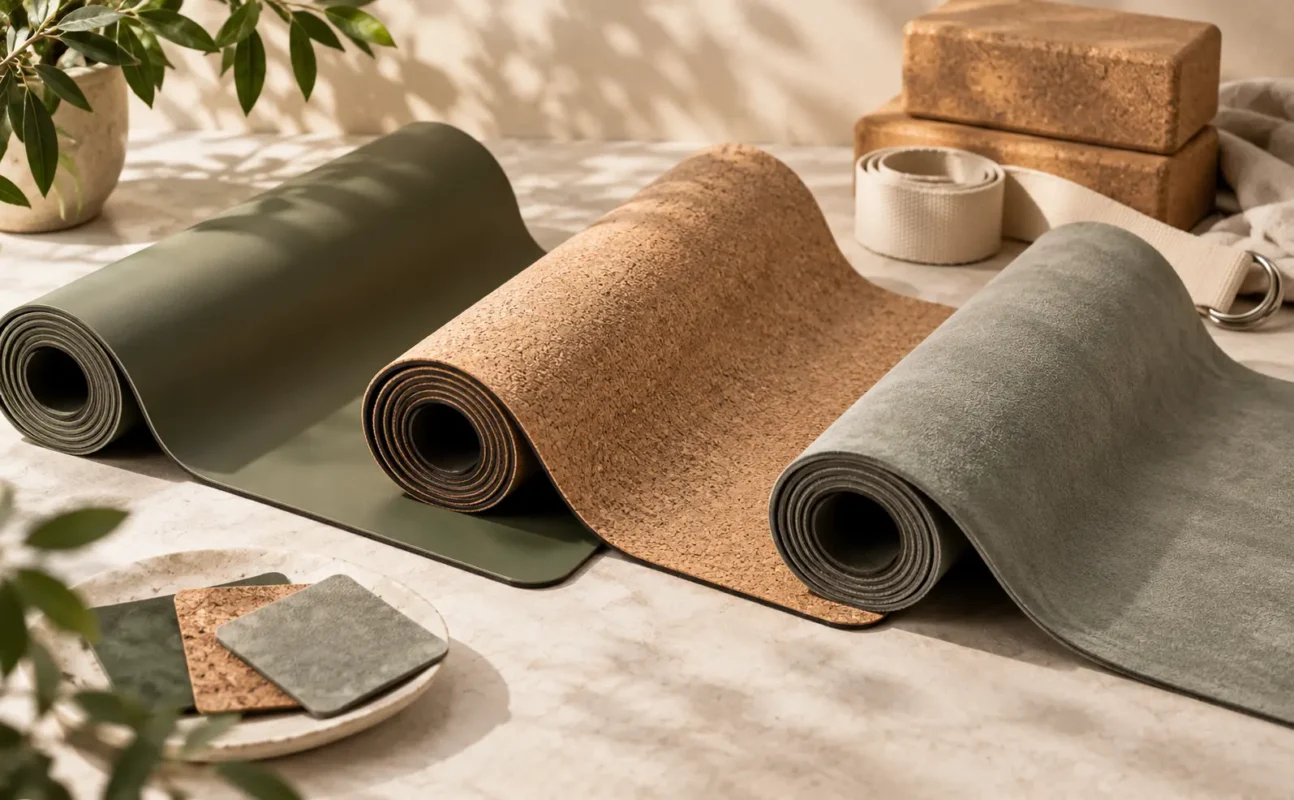
A natural rubber yoga mat uses natural rubber as its main base material. The rubber can be used as the complete mat structure or combined with an upper layer such as PU, cork, suede, or printed textile.
The dense rubber base generally provides strong contact with the floor and helps the mat remain stable during standing poses.
Natural rubber mats are normally heavier than TPE and PVC mats, which may increase carton weight, international freight, and e-commerce fulfillment costs.
New products may also have a noticeable natural rubber smell. The material requires appropriate cleaning and storage and should generally be protected from prolonged sunlight, excessive heat, long-term moisture, and unsuitable chemical cleaners.
People with sensitivity to natural latex may also need to consider whether the product is appropriate for them.
View available natural rubber yoga mat options.
Natural rubber yoga mats are generally denser and heavier than TPE and many PVC mats. They usually lie flat well and provide strong floor grip, making them suitable for professional practice, premium collections, and grip-focused product lines.
Natural rubber can also be combined with different upper surfaces to achieve specific performance and visual effects.
Typical characteristics include:
The upper surface determines the user-facing grip. For example, a PU natural rubber mat performs differently from a cork or suede natural rubber mat, even though they share a similar base.For a detailed comparison of these upper surfaces, review our guide to PU vs cork vs suede yoga mats.
Natural rubber generally provides the strongest contact with the floor. However, hand and foot grip depend on the upper surface, texture, perspiration level, and whether the surface is open-cell or closed-cell.
TPE usually provides good dry grip for general practice. PVC grip can also be effective when the formulation and embossed texture are properly designed. Performance can vary significantly within both material categories.
For moisture-heavy practice, PU natural rubber is often selected because the PU surface can provide stronger wet grip. Buyers developing hot yoga mats should test realistic samples rather than rely only on a material description.
See PU natural rubber yoga mats for a wet-grip-focused product structure.
TPE usually feels soft and light. PVC cushioning can be adjusted through density, thickness, and foaming structure. Natural rubber generally feels denser and more grounded.
A thicker mat is not automatically more supportive. A low-density 8 mm mat may feel soft but reduce balance, while a dense 4 mm or 5 mm mat may provide more stable support.
Wholesale buyers should compare thickness, density, unit weight, rebound, and actual sample feel together. Looking only at the number of millimeters can lead to an inaccurate comparison.
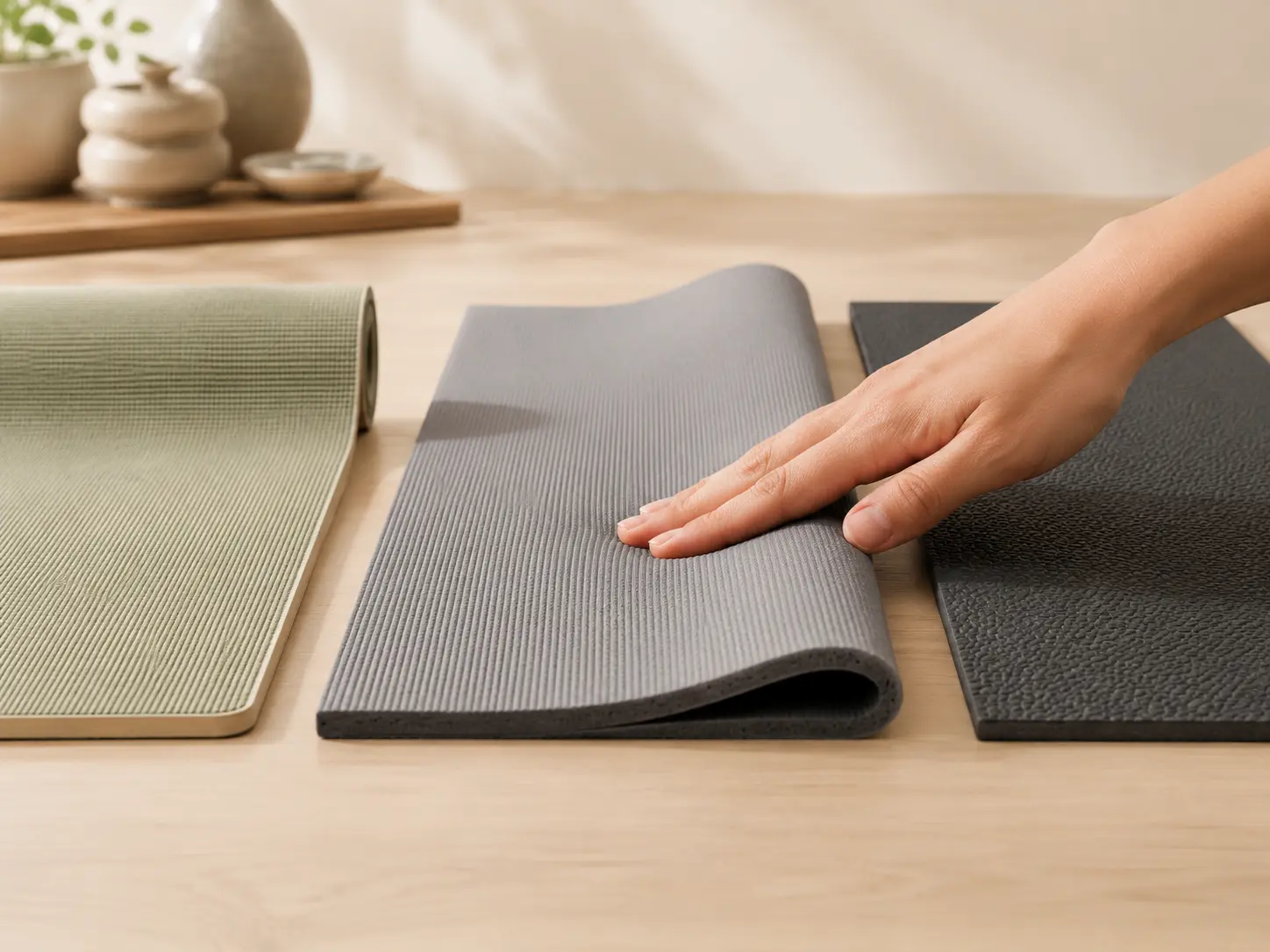
High-quality PVC generally offers strong wear resistance, but the lifespan of all three materials depends on usage, storage, cleaning, density, and manufacturing quality.
PVC is often suitable for frequent use and moisture exposure. TPE performs well in normal use but should be protected from prolonged heat, sunlight, abrasion, and sharp objects. Natural rubber is dense and stable but requires suitable cleaning and dry storage.
During sample inspection, buyers should check:
Durability claims should be based on the final specification rather than the material category alone.
TPE is usually the lightest option. PVC weight varies with density, size, and thickness, while natural rubber is generally the heaviest.
For B2B buyers, product weight affects:
A heavy mat may support premium positioning and better stability, but it may also reduce the number of units per shipment. Buyers should request unit weight, carton dimensions, carton quantity, and gross weight after the final specification is confirmed.
PVC is generally easy to wipe and resistant to everyday moisture. TPE can usually be cleaned with a lightly damp cloth and should be dried completely before storage.
Natural rubber requires more careful maintenance. Strong chemical cleaners, prolonged soaking, and direct sunlight may damage the product.
Cleaning instructions must also match the upper surface. PU, cork, suede, and textile surfaces should not automatically use the same cleaning method as closed-cell TPE or PVC.
Brands should provide care instructions based on the final product structure.
New yoga mats may have an initial material odor. Its intensity depends on raw materials, formulation, packaging time, storage, and ventilation.
TPE usually has a relatively mild odor, but it should not be described as completely odor-free without evidence. PVC may have a noticeable initial smell after sealed storage. Natural rubber can carry its characteristic rubber odor.
Buyers should assess odor immediately after opening and again after ventilation. This provides a more realistic understanding than checking only a newly unsealed sample.
Natural rubber usually has the strongest natural-material positioning, while TPE is often marketed as an alternative to conventional PVC. However, the main material name does not determine the complete environmental impact.
TPE is not automatically natural, biodegradable, or recyclable in every location. PVC performance depends on the complete formulation, restricted-substance control, product lifespan, and end-of-life treatment. Natural rubber products may still contain pigments, adhesives, printing inks, upper layers, and packaging.
Environmental positioning should consider the full product structure, expected lifespan, manufacturing process, packaging, and disposal options.
Buyers should avoid unsupported claims such as:
Any environmental, safety, or compliance statement should match the final product composition and available documentation.
PVC generally supports the broadest price range and is often suitable for entry-level, promotional, and high-volume programs.
TPE is commonly positioned in the mainstream mid-range market because it combines light weight, cushioning, and visual variety.
Natural rubber is usually positioned higher because of its density, floor grip, weight, and compatibility with PU, cork, or suede surfaces.
What affects the cost of custom yoga mats? The main factors include:
Size
Buyers should provide complete specifications before comparing quotations. Two mats with the same size and material name may have different costs because their density, surface, printing, and packaging are different.
When evaluating custom yoga mat materials, buyers should confirm the base material, upper surface, logo process, and packaging requirements together.
TPE supports dual-layer structures, two-color combinations, Pantone colors, surface textures, embossed branding, and selected printing processes.
PVC supports different colors, embossed patterns, thicknesses, densities, printed designs, and retail packaging. It is often practical for large-volume programs.
Natural rubber is frequently customized through PU, cork, suede, or printed textile upper surfaces. Available branding may include screen printing, laser marking, UV printing, heat transfer, or digital printing, depending on the structure.
Not every logo process is suitable for every surface. Buyers should confirm the material, artwork size, color count, print coverage, and required wear resistance before selecting a branding method.
Pureasana supports material, color, size, logo, and packaging customization through wholesale, OEM, ODM, and private-label yoga mat services.
PVC is often practical for promotional campaigns, schools, fitness events, and price-sensitive retail. It supports flexible specifications and generally good durability.
Brands that emphasize natural-material messaging should confirm whether PVC matches their communication strategy.
TPE is suitable for beginner-friendly, portable, and mainstream products. Its lower weight can benefit both consumers and e-commerce shipping.
Buyers should verify density, rebound, tear resistance, grip, and roll-flat performance before approval.
Natural rubber or PU natural rubber is commonly selected for premium and grip-focused products. The dense base supports floor stability, while the upper surface determines dry or wet grip.
Buyers should account for product weight, odor, cleaning instructions, retail price, and freight cost.
Cork combined with natural rubber suits boutique yoga brands and wellness collections that require a distinctive natural appearance.
Review cork natural rubber yoga mats.
Understanding how to choose yoga mat materials for wholesale starts with defining the target market, product positioning, performance requirements, customization needs, and logistics.
Material choice affects grip, cushioning, durability, product weight, customization, packaging, shipping cost, and retail pricing. Confirming these requirements early can make quotations more accurate and reduce unnecessary sample revisions.
First, determine whether the yoga mat is intended for an entry-level, mainstream, or premium collection.
Buyers should also clarify the main sales channel, such as e-commerce, yoga studios, sporting-goods stores, promotional projects, or traditional retail. A price-sensitive market may favor PVC, while lightweight mainstream products often use TPE. Natural rubber is more commonly considered for premium or grip-focused collections.
Common yoga mat sizes may include:
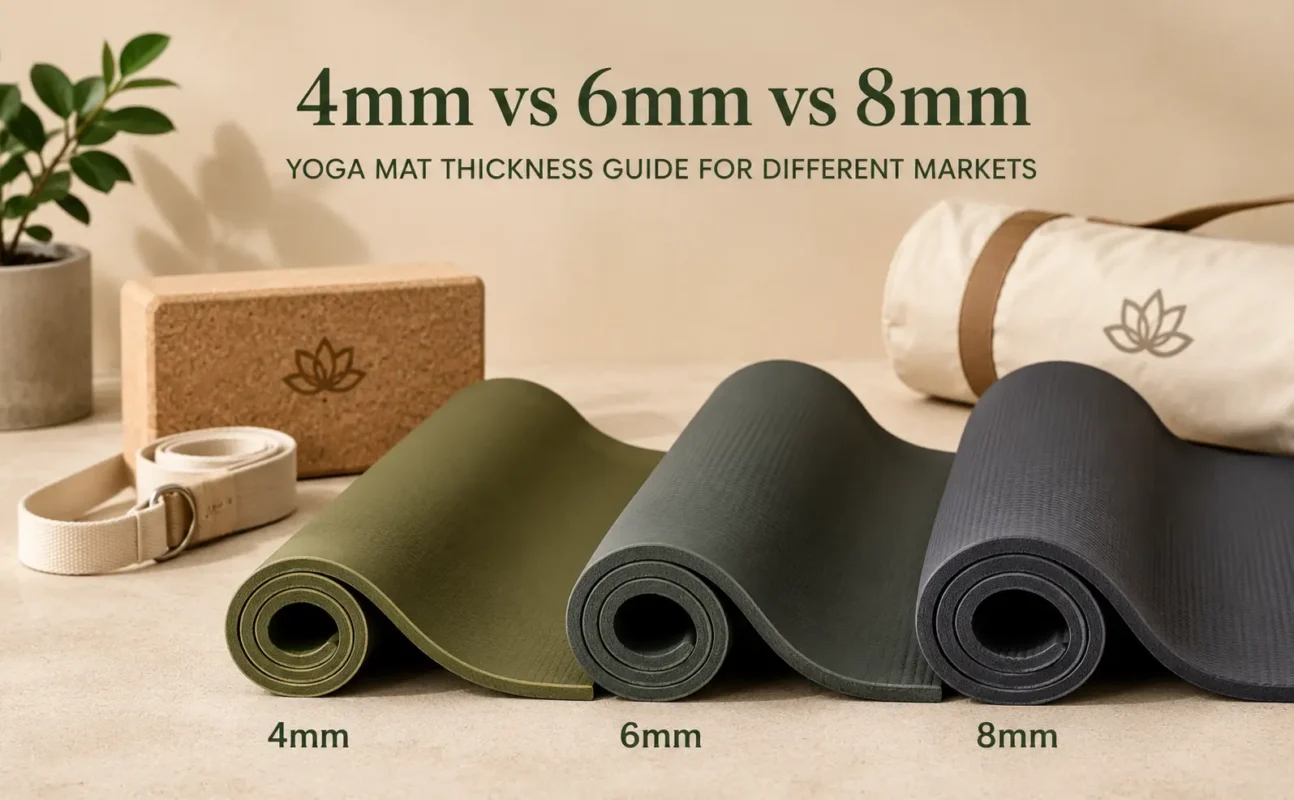
Common thickness options may include 4 mm, 5 mm, 6 mm, 8 mm, or customized thicknesses.
Thickness should not be evaluated alone. Density also affects cushioning, stability, durability, unit weight, shipping cost, and the overall feel of the finished mat.
Buyers should confirm both the main material and the complete product structure.
Possible structures include:
Two products with the same base material may perform differently when their upper surfaces, densities, textures, or layer structures are different.
The required grip should match the intended yoga style and user group.
A general home-practice mat may require reliable dry grip, while a hot yoga product may need stronger wet grip. Buyers should also distinguish between surface grip for hands and feet and floor grip on the underside of the mat.
Actual samples should be tested under realistic use conditions before final approval.
Logo requirements should be confirmed before sampling because not every branding process is suitable for every surface.
Buyers should provide:
Depending on the material and surface, possible methods may include embossing, screen printing, UV printing, laser marking, heat transfer, or digital printing.
Packaging affects product presentation, MOQ, cost, carton size, and production time.
Common options include:
Custom-printed packaging should be discussed early because it may require separate artwork confirmation, sampling, and minimum-order quantities.
Packaging affects product presentation, MOQ, cost, carton size, and production time.
Common options include:
Custom-printed packaging should be discussed early because it may require separate artwork confirmation, sampling, and minimum-order quantities.
Buyers should provide the estimated order quantity, required delivery date, destination market, and any testing requirements before requesting a final quotation.
Pureasana’s regular MOQ is typically around 100 pieces, depending on the product and customization requirements. Standard samples generally take about 3–7 days, while customized samples may require approximately 10–20 days. Bulk production usually takes around 25–40 days after final approval.
Actual MOQ and lead time depend on the material, specifications, logo process, packaging, quantity, and testing requirements.
Choosing a yoga mat based only on price or material name can lead to incorrect specifications, unexpected shipping costs, and products that do not match the intended market. Wholesale buyers should evaluate the complete product structure, performance, customization, and logistics before approving an order.
Two yoga mats with the same thickness can feel and perform very differently when their densities are not the same. A low-density mat may feel softer but provide less stability, while a denser mat may offer stronger support and better resistance to compression.
Buyers should compare thickness, density, unit weight, cushioning, and stability together.For a more detailed comparison across different product positions, see our 4mm vs 6mm vs 8mm yoga mat thickness guide.
Not all TPE, PVC, or natural rubber yoga mats have the same quality or performance. Formulation, foaming consistency, surface texture, layer structure, and manufacturing control can create significant differences within the same material category.
Buyers should evaluate actual samples instead of selecting a product only because of its material name.
Product weight affects portability, carton loading, international freight, warehouse handling, and e-commerce fulfillment costs.
Natural rubber mats are generally heavier than TPE mats, while PVC weight can vary depending on density and thickness. Buyers should confirm unit weight, carton quantity, carton dimensions, and gross weight before finalizing the order.
The logo method should be considered before the final material and surface structure are approved. Different surfaces may support embossing, screen printing, UV printing, laser marking, heat transfer, or digital printing.
Late artwork changes may affect sample cost, MOQ, production time, and the appearance of the finished product.
A yoga mat should not automatically be described as completely eco-friendly, biodegradable, non-toxic, or universally recyclable simply because it uses TPE or natural rubber.
Environmental and safety claims should reflect the complete product structure, including the base material, upper surface, adhesives, inks, packaging, and available testing or documentation. Buyers should confirm which claims can be supported before using them in product listings or packaging.
TPE is generally suitable for lightweight and versatile mainstream mats. PVC is practical for durable, cost-sensitive, and high-volume lines. Natural rubber is commonly selected for strong floor grip, dense support, and premium positioning.
The final choice in the TPE vs PVC vs natural rubber yoga mats comparison depends on the target market, expected retail price, grip, weight, customization, and logistics.
For B2B buyers, the best approach is to define the product position first and select the material second. The chosen material should support the customer experience, brand message, price level, shipping strategy, and quality requirements.
TPE is usually lighter and softer, while PVC often offers strong durability and broader price positioning. Neither material is automatically better.
The choice depends on density, grip, target market, product weight, required durability, and expected retail price.
Natural rubber generally provides stronger floor grip and denser support. TPE is lighter and easier to carry.
Natural rubber suits premium or grip-focused products, while TPE is practical for lightweight mainstream collections.
TPE and PVC can both suit beginners. TPE emphasizes softness and portability, while PVC offers durability and flexible pricing.
Density, stability, surface texture, and thickness should also be considered. The material name alone does not determine whether a mat is beginner-friendly.
PU natural rubber is often selected for hot yoga because the PU surface can provide stronger wet grip.
Performance varies by surface formulation, texture, and moisture level. Buyers should test samples under realistic conditions before making wet-grip or hot-yoga claims.
TPE suits lightweight mainstream collections, PVC suits promotional and price-sensitive lines, and natural rubber supports premium positioning.
Buyers should also compare logo compatibility, MOQ, packaging, unit weight, target price, and testing requirements.
Yes. All three materials can be customized in color, size, thickness, texture, logo, printing, and packaging.
The available process depends on the material, surface structure, artwork, order quantity, and performance requirements.
Explore Product Materials