EMAIL
BESPOKE INQUIRY
pureasanaofficial@gmail.com
Explore Articles by Topic:

Yoga product sourcing in 2026 is no longer a simple comparison of unit price, minimum order quantity (MOQ), and production capacity. Brands and importers are also evaluating product positioning, material credibility, packaging efficiency, inventory exposure, quality documentation, and supplier development support.
Broader wellness research published in 2026 indicates that consumers increasingly assess products by functional attributes, transparency, and personal fit. Sporting-goods companies also continue to balance selective spending, innovation, and supply-chain resilience. For yoga buyers, the practical implication is clear: define the customer first, build a focused value proposition, and treat packaging, quality, and supplier capability as part of the product.Health & Wellness in 2026: Winning the self-directed, results-driven consumer
This guide explains the key 2026 yoga product sourcing trends and how brands and importers can respond.
No material, customization plan, or supplier model suits every brand. The right decision depends on the destination market, order quantity, inventory plan, required claims, sales channel, and acceptable landed cost.
Price remains important, but the lowest factory quotation does not always create the best commercial result. A value-driven yoga sourcing strategy compares the complete value of a product, including performance, shipping efficiency, defect risk, customization, and repeat-order consistency.
A lower-priced mat may be heavier, require larger cartons, or offer little differentiation. A slightly higher product cost may be justified by a more suitable texture, better packaging efficiency, clearer branding, or more stable quality.
Material, size, thickness, density, product weight, customization, packaging, quantity, testing, and freight all contribute to the final landed cost. Buyers should compare quotations based on matching specifications rather than unit price alone.Before requesting quotations, buyers should define:
This information helps the supplier recommend a realistic product instead of simply quoting the cheapest mat.
Broader sporting-goods research shows a market balancing cautious consumers with continued demand for relevant innovation. For yoga sourcing, this suggests that added features should solve a customer need rather than increase cost without strengthening the offer.Sporting Goods 2025—The new balancing act: Turning uncertainty into opportunity
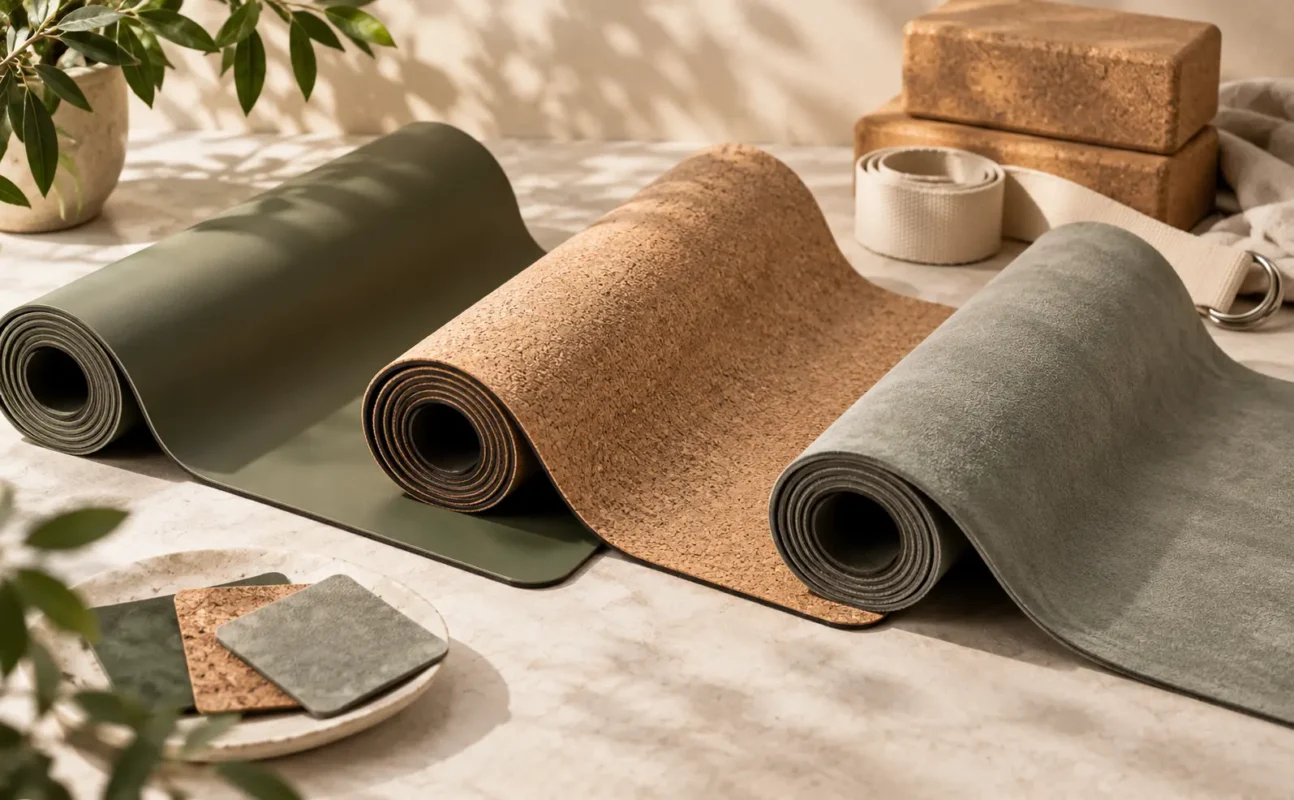
Material choice is central to yoga mat sourcing, but it should connect directly to performance, price, product weight, shipping, target customer, and supportable claims. Buyers should avoid choosing a material only because it is described as “premium,” “natural,” or “eco-friendly.”
Material choice is central to yoga mat sourcing, but it should connect directly to performance, price, product weight, shipping, target customer, and supportable claims.Suitable materials depend on the intended positioning and product structure rather than one universal ranking. Common sourcing positions include:
These are general directions, not fixed rules. Formulation, density, thickness, texture, and layer construction can significantly change performance.
A responsible review should include material composition, durability, packaging, supplier documents, testing needs, and claim wording.
Current wellness research emphasizes transparent product information and credible functional attributes. For yoga brands, unsupported claims such as “completely non-toxic,” “fully biodegradable,” or “100% eco-friendly” may create more risk than value. This is a sourcing implication drawn from broader wellness research rather than a yoga-specific consumer survey.
Buyers should confirm what documents are available, which formulation they cover, and whether the same material will be used in bulk production.
Private label yoga products need more than basic logo customization to stand out.A recognizable collection should combine specifications, visual consistency, packaging, and a defined customer use case.
NIQ’s broader private-label research shows that consumers increasingly view private labels as credible alternatives to national brands, while quality, innovation, trust, and product information remain important. The research covers consumer goods generally rather than yoga equipment specifically, but it provides a useful sourcing signal: private-label buyers need a real product proposition rather than price competition alone.NIQ’s Global Report Reveals Challenges and Opportunities for Private Label and Branded Product Growth
A simple project may include:
This approach can suit promotional use, a price-sensitive launch, or a small range extension.
A more developed project may add:
Every additional feature should have a commercial purpose because custom structures, colors, printing, and packaging can affect MOQ, sampling, unit cost, and lead time.
Brands may coordinate mats with yoga blocks, straps, bags, towels, or other accessories.
A collection does not automatically sell better, but consistent colors, branding, and packaging can strengthen presentation and simplify purchasing when the supplier can manage the products reliably.For a practical framework covering product combinations, retail price tiers, packaging, MOQ, and inventory planning, read our yoga product bundles guide.
Yoga product packaging should be planned during development rather than after production. Packaging affects product protection, carton size, freight efficiency, labeling, online presentation, and compliance responsibilities.
For brands selling in the European Union, packaging planning is especially timely. The EU Packaging and Packaging Waste Regulation entered into force in February 2025 and generally applies from August 12, 2026. It covers packaging placed on the EU market and introduces requirements and longer-term targets related to packaging reduction, recyclability, recycled content, and reuse.
Exact obligations and transition dates depend on the packaging type and economic operator, so importers should review official guidance for their specific sales model.Packaging waste
EU rules on packaging and packaging waste, including design and waste management.
Key sourcing questions include:
An oversized box can reduce carton quantity and raise freight volume, while packaging that is too tight may deform the mat.

One of the most practical 2026 yoga product sourcing trends is the use of controlled launches for new brands, materials, colors, or designs before demand is fully tested. The goal is not the lowest possible MOQ, but a quantity that supports practical production while limiting excess inventory.
A structured launch usually includes:
Very low quantities can increase unit cost, color-matching charges, packaging cost, and material waste. Buyers should compare the inventory risk of a larger order with the higher unit cost of a smaller launch.
At Pureasana, regular MOQ is typically around 100 pieces, depending on the product and customization. Standard samples generally take about 3–7 days, custom samples about 10–20 days, and bulk production about 25–40 days. Actual timing depends on material, logo, packaging, quantity, and final specifications.
The first order can act as a commercial validation order, but it should still be documented well enough for repeat production.
Brands planning a smaller first order can also review our yoga mat MOQ guide to understand which customization choices usually raise the production minimum.
Planning a private-label yoga mat order? Pureasana can help review the material, construction, dimensions, branding, packaging, and inspection points before bulk production.
[Discuss Your Private-Label Project]
Quality control should begin when the product is defined, not only when finished cartons are waiting for shipment. Early measurable standards make production differences easier to identify and correct.
A practical quality file may include:
Testing requirements depend on the material, intended use, destination country, and buyer standards. Reports should be checked for the tested product, material, date, scope, and laboratory information rather than treated as universally applicable.
The growing emphasis on transparency in wellness markets also supports consistent information across packaging, product pages, and supplier documents.
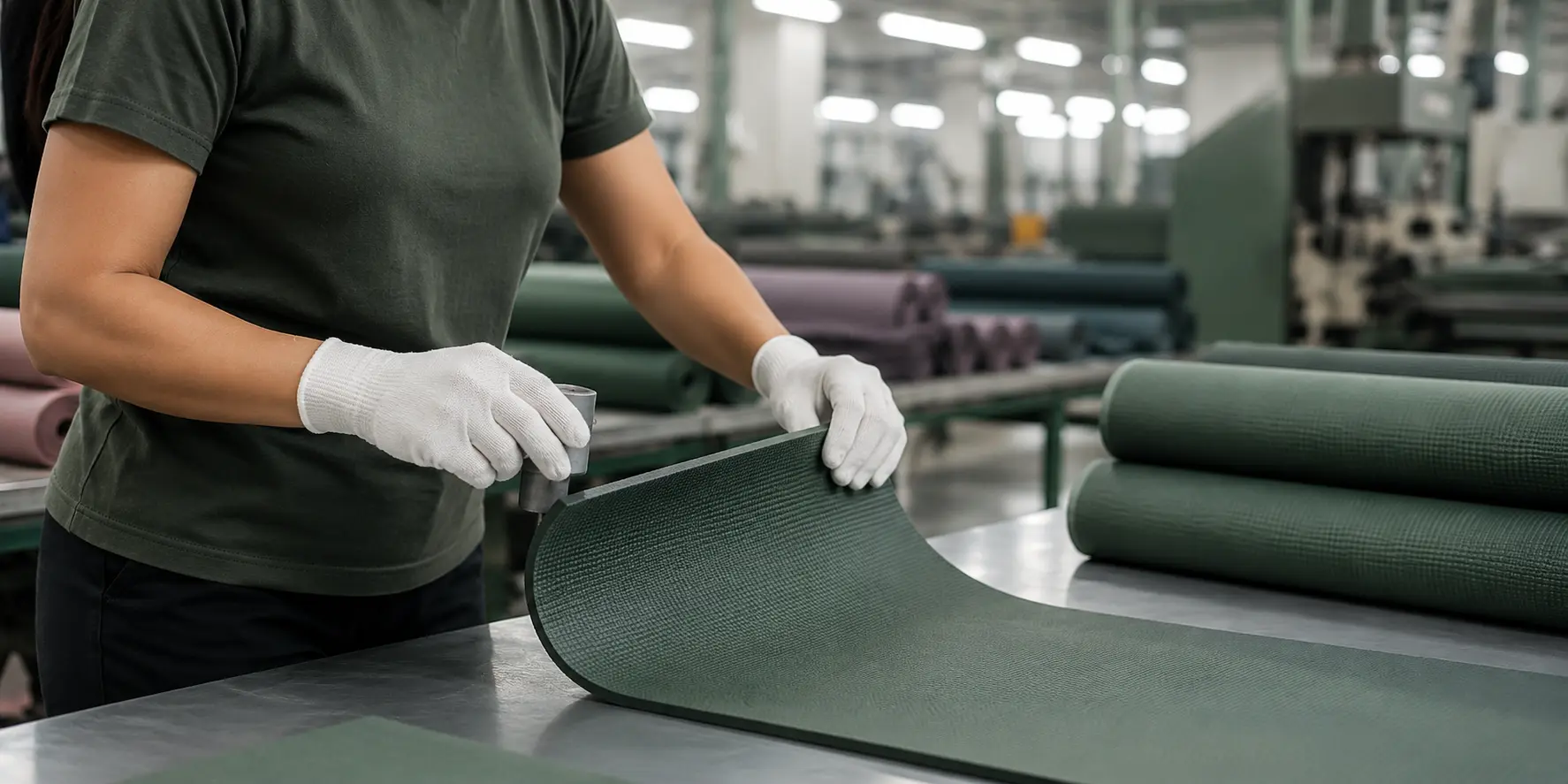
Yoga product supplier selection should assess more than catalogs and quotations. Reliable sourcing depends on whether the supplier can translate a concept into specifications, identify risks, communicate changes, and reproduce the approved result.
The OECD describes resilient supply chains as agile, adaptable, and aligned. Applied to yoga sourcing, this supports better visibility, clear product records, realistic alternatives, and earlier communication of production or delivery risks. This is a practical sourcing inference from the OECD’s broader supply-chain framework.OECD Supply Chain Resilience Review
|
Evaluation Area |
What Buyers Should Check |
|---|---|
|
Product capability |
Materials, structures, sizes, and accessories |
|
Development support |
Sampling, artwork review, and specification confirmation |
|
Quality management |
Raw-material, in-process, finished-product, and shipment checks |
|
Documentation |
Material records, reports, packing details, and order history |
|
Communication |
Technical clarity and problem resolution |
|
Production flexibility |
MOQ, colors, packaging, and reorder support |
|
Delivery planning |
Lead time, capacity, and shipment updates |
A broad product range is valuable only when the supplier can manage specifications and quality across it.
Brands should also keep approved materials, artwork versions, and packaging files internally instead of relying only on chat history.
A clear sourcing brief explains who the product is for, where it will be sold, what performance is required, and which cost and time limits shape the project.
Buyers should provide:
A target price is useful, but it should not replace the specification. Without material, density, thickness, packaging, and quality details, quotations may describe products that are not comparable.
When the material is uncertain, buyers can describe the intended result, such as lightweight shipping, stronger wet grip, dense studio support, or a premium natural appearance. The supplier can then recommend structures for sampling.
|
Sourcing Priority |
What Buyers Should Confirm |
|---|---|
|
Market positioning |
Target customer, channel, and retail range |
|
Product value |
Material, performance, weight, and landed cost |
|
Differentiation |
Color, texture, logo, structure, and accessories |
|
Packaging |
Retail format, labels, barcodes, and carton efficiency |
|
Launch planning |
Samples, MOQ, first order, and reorder plan |
|
Quality |
Specifications, tolerances, documents, and inspection |
|
Supplier capability |
Communication, production, and delivery support |
The checklist should be adjusted for the product, market, order size, and brand stage. A new private-label launch usually needs more sample review than a repeat order of an established product.
The main 2026 yoga product sourcing trends point toward more deliberate planning. Competitive pricing still matters, but brands also need clear positioning, credible material information, purposeful customization, efficient packaging, controlled launches, documented quality, and dependable supplier communication.
The best sourcing decision depends on the target customer, sales channel, retail position, inventory plan, destination market, and risks the brand is prepared to manage.
Planning a yoga mat or accessory collection? Share your product type, target market, material, specifications, quantity, logo, packaging, target position, and delivery schedule with Pureasana.
We can help review the project before sampling and quotation.
Importers should source products that fit a defined customer and price position rather than chase an assumed universal bestseller. Mats, blocks, straps, bags, and coordinated sets can all be suitable when their material, performance, packaging, and landed cost match the sales channel.
Sustainable positioning is important, but it is not the only factor. Buyers should also evaluate performance, durability, weight, packaging, cost, documentation, and target-market requirements. Claims should be specific and supportable rather than based only on a material name.
Brands can reduce risk with a clear brief, relevant samples, an approved specification sheet, confirmed packaging, and a reasonable first-order quantity. Pre-shipment inspection and a documented reorder specification also make it easier to correct problems and reproduce successful products.
Importers should compare product capability, development support, quality control, documentation, communication, flexibility, and delivery planning. Buyers should confirm how the supplier manages specifications, changes, defects, repeat orders, and delays before building a long-term relationship.
Explore Product Materials