EMAIL
BESPOKE INQUIRY
pureasanaofficial@gmail.com
Explore Articles by Topic:
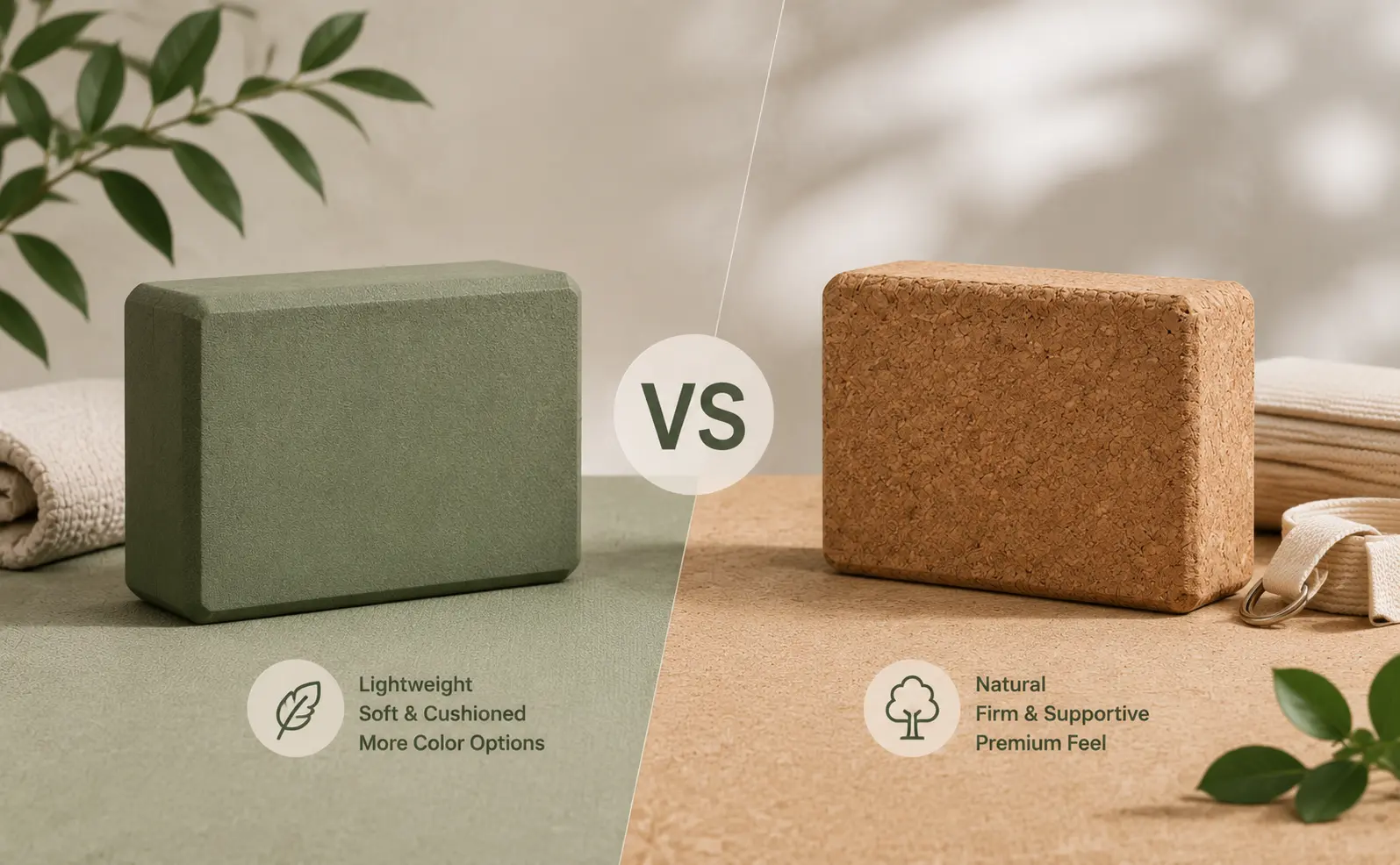
For yoga brands, importers, distributors, and private-label buyers, choosing between EVA and cork yoga blocks affects product positioning, customization, shipping weight, packaging, and retail pricing.
The EVA vs cork yoga blocks comparison is especially important when building a yoga accessories collection. EVA blocks are generally lighter, softer, and available in more colors, while cork blocks usually feel firmer and have a more natural appearance. Neither material is best for every brand. The right option depends on the target customer, sales channel, specifications, budget, and brand image.
Neither material is universally better. The right choice depends on your target customer, retail positioning, customization requirements, shipping model, and purchasing budget. Brands serving different market segments may also use EVA as a core option and cork as an upgraded alternative.
An EVA yoga block is a lightweight foam support block made from ethylene-vinyl acetate. Its firmness, cushioning, weight, and durability depend mainly on foam density and product construction.
EVA blocks usually feel softer than cork and are common in beginner collections, home fitness sets, promotional bundles, and general retail lines.
However, low-density and high-density EVA blocks can perform very differently. Buyers should confirm density, weight, dimensions, compression recovery, and surface quality before bulk production.
A cork yoga block is commonly made from compressed cork granules formed into a dense structure. Cork blocks generally feel firmer and heavier than EVA blocks and have a natural brown surface.
Cork yoga blocks are often used in studio collections, natural-material ranges, and mid-to-premium accessory lines.
Final quality depends on cork particle consistency, compression, bonding, edge strength, moisture control, and finishing. A natural appearance does not automatically prove that every part of the finished product is recyclable or biodegradable.
The main differences between EVA and cork yoga blocks are firmness, cushioning, weight, appearance, customization, shipping cost, and target market.
|
Comparison Factor |
EVA Yoga Blocks |
Cork Yoga Blocks |
|---|---|---|
|
Material structure |
Foam with different density |
Compressed cork granules |
|
Surface feel |
Softer and more cushioned |
Firmer and more solid |
|
Weight |
Generally lighter |
Generally heavier |
|
Compression |
Depends strongly on density |
Usually less visible compression |
|
Color options |
Wide custom color range |
Mainly natural cork tones |
|
Cleaning |
Usually easy to wipe |
Requires controlled moisture exposure |
|
Price position |
Entry-level to mid-range |
Mid-range to premium |
|
Shipping |
Lower product weight |
Higher weight and more edge protection |
|
Target market |
Beginners, e-commerce, and sets |
Natural, studio, and premium collections |
This yoga block material comparison is most useful when buyers evaluate products with comparable dimensions, weight, density, finish, and packaging.
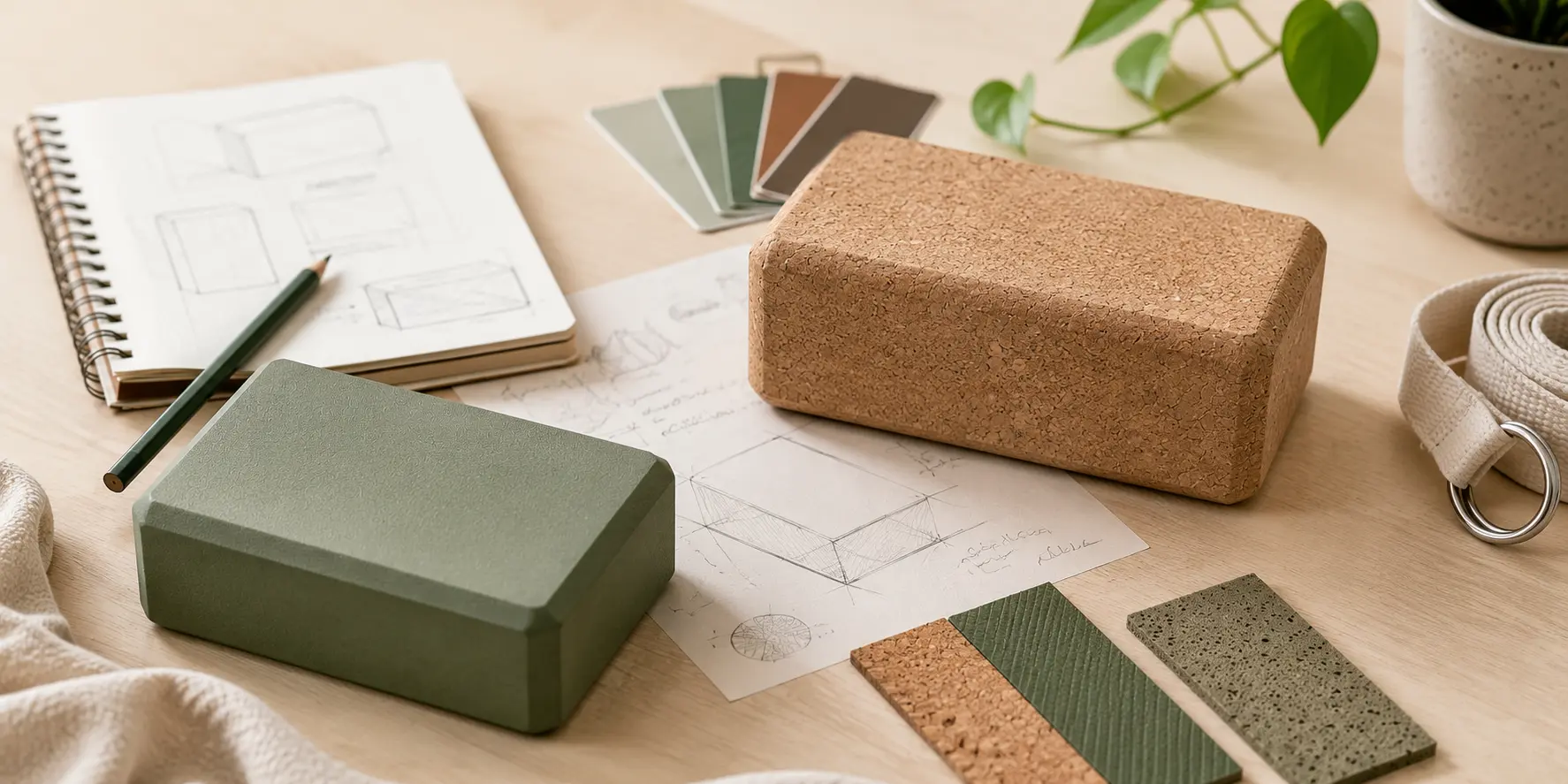
Cork yoga blocks generally provide firmer support, while EVA yoga blocks provide more cushioning. Cork therefore suits collections emphasizing stability, while EVA may be more comfortable for beginners or users who prefer a softer contact surface.
High-density EVA can feel much firmer than lightweight foam. Buyers should test samples for compression, recovery, edge stability, and hand feel instead of choosing only by material name.
Neither material is automatically more durable. EVA durability depends on density, compression recovery, surface quality, and shape retention. Cork durability depends on compression quality, particle bonding, and resistance to edge chipping.
Low-density EVA may develop dents or lose shape. Better-density EVA usually holds its structure more effectively. Cork often resists compression well, but weak edges or poor bonding can cause cracks or particle shedding. Sample inspection is therefore more reliable than a general material claim.
EVA yoga blocks are generally easier to wipe clean, while cork blocks require more careful moisture and storage management.
Cork should not remain wet or be stored in persistently humid conditions. Brands should include practical care instructions and avoid unsupported claims such as “antibacterial,” “odor-free,” or “completely hygienic.”
EVA is usually easier to manage for weight-sensitive e-commerce and international shipping. Cork is denser, so buyers should pay more attention to individual weight, carton gross weight, and edge protection.
Buyers should compare total landed cost rather than factory unit price alone because carton quantity, handling risk, and possible transit damage also matter.
The cost of custom yoga blocks depends on more than material. Size, density, product weight, logo method, packaging, quantity, and quality requirements can all change the quotation.
For EVA, key factors include density, dimensions, color, weight, and finishing. For cork, pricing may be influenced by granule quality, compression, size, weight, and branding method.
Packaging also changes landed cost. Paper sleeves, shrink wrap, insert cards, kraft boxes, and full-color retail boxes have different material and labor requirements.
Cork blocks may require additional corner protection, while EVA blocks are often easier to pack for lower gross weight. When sourcing wholesale yoga blocks, buyers should request carton quantity, carton dimensions, net weight, and gross weight before comparing offers.
Cork is often positioned in mid-range or premium collections, while EVA can cover entry-level, promotional, and mid-range products. Packaging, logo quality, finishing, and coordination with the full collection also influence retail positioning.
EVA generally offers more color flexibility, while cork is better for brands that want to preserve a natural material appearance. Both can support custom yoga blocks, but their branding options differ.
EVA blocks can usually be developed in a wider range of colors. This makes them suitable for coordinated collections and branded sets with Yoga Straps products or yoga mats. Custom colors may affect MOQ, sample time, and production scheduling.
Cork blocks normally retain natural tones. Brand differentiation usually comes from the logo, printed pattern, paper sleeve, insert card, or retail box. Because natural texture can vary, buyers should agree on an acceptable color and surface range during sample approval.
Possible branding methods include screen printing, suitable transfer methods, laser engraving for certain cork structures, branded sleeves, insert cards, and boxes.
Buyers should approve the actual logo size, position, color, clarity, and adhesion on a physical sample. A broader overview of branding and packaging is available through Pureasana’s OEM & ODM.
Custom colors, special sizes, new logo tools, printed packaging, and nonstandard structures may affect MOQ and lead time.
At Pureasana, a regular MOQ is typically around 100 pieces, depending on the product and customization requirements. Standard samples generally take about 3–7 days, while customized samples may take about 10–20 days. Bulk production usually takes about 25–40 days after confirmation, depending on material, logo, packaging, quantity, and order details.Brands planning a broader private-label collection can also review our complete guide to custom yoga mats for private label brands for a detailed development framework covering specifications, logo methods, packaging, MOQ, samples, and approval.
Buyers should check dimensions, weight, firmness, surface condition, edges, logo accuracy, and packaging before bulk production.
Check the following:
Check the following:
Natural texture variation is not automatically a defect. Acceptable and unacceptable differences should be agreed before production.
A pre-production sample confirms actual firmness, weight, color, logo effect, packaging dimensions, and product positioning.
The approved sample should record final dimensions, target weight, surface standard, logo size and position, packaging layout, and acceptable appearance range. It can then support bulk inspection. Buyers can also review Key Yoga Mat Quality Control Checks for Bulk Orders for broader inspection planning.
Brands should compare EVA and cork according to the target market, retail level, shipping model, product specifications, and collection strategy rather than assume one material is always better.Brands developing a wider yoga range can use our yoga mat buying guide for brands to compare customer fit, product positioning, finished weight, landed cost, sales channels, and samples across the collection.
EVA is usually suitable when:
EVA should not automatically be treated as low-end. A higher-density block with controlled weight, clean finishing, and professional packaging can support stronger positioning.
Cork is usually suitable when:
Offering both materials can create clear product tiers. EVA can be the core, colorful, or beginner option, while cork can be the natural, studio, or premium alternative.
More choices also create more SKUs and inventory pressure. For a first order, buyers may begin with limited colors and packaging formats, then expand after reviewing sales. This approach can support a broader Yoga Accessories collection without overcomplicating inventory.
For broader guidance on controlled launches, packaging, inventory risk, and supplier planning, review the 2026 yoga product sourcing trends for brands and importers.Brands planning to combine mats, blocks, straps, and packaging as one retail offer can review our guide to yoga product bundles for brands.
Common sourcing mistakes often happen because buyers compare products only by appearance or unit price, without confirming the specifications that affect performance, consistency, and landed cost.
1. Comparing material names instead of actual density and construction.
Two EVA blocks can have very different firmness, weight, compression, and shape retention even when both are described as EVA. Cork blocks can also vary in particle distribution, compression quality, surface finishing, and edge strength. Buyers should compare approved samples, individual weight, density, dimensions, and physical performance rather than relying only on the material name.
2. Focusing only on unit price and ignoring landed cost.
A lower factory price does not always result in a lower total purchasing cost. Product weight, carton quantity, carton dimensions, packaging materials, handling requirements, and shipping method can all affect the final landed cost. This is especially important when comparing lightweight EVA blocks with heavier cork blocks.
3. Approving a logo without testing it on the final product surface.
Logo clarity, adhesion, color, and durability can change depending on the material texture and branding method. A logo that looks clear in a digital design may appear uneven on textured EVA or less consistent on natural cork. Buyers should approve the actual logo size, position, color, and finish on a completed sample before bulk production.
4. Treating natural cork variation as a quality defect without an agreed standard.
Cork yoga blocks may show reasonable differences in texture, grain, and color because of the natural material. These variations should be separated from actual problems such as cracks, excessive particle shedding, uneven compression, or damaged edges. Buyers and suppliers should confirm acceptable appearance ranges during sample approval to avoid disputes during final inspection.
5. Making unsupported sustainability claims based only on natural appearance.
A cork surface may support a natural or sustainability-focused brand image, but appearance alone does not prove that the finished product is fully biodegradable, recyclable, or free from restricted substances. Environmental claims should consider material sourcing, bonding components, production, packaging, durability, transportation, and available supporting documents.
A complete quotation request should include the preferred material, size, product weight or density, estimated quantity, logo requirements, packaging type, target market, target price, and required delivery schedule. Clear specifications help suppliers recommend a more suitable product and provide a more accurate quotation.
The EVA vs cork yoga blocks decision should be based on product positioning rather than one performance factor. EVA is generally better for lightweight, colorful, e-commerce, set-based, and price-sensitive collections. Cork is generally better for natural-looking, firm, studio-focused, and mid-to-premium products.
Both materials can support a successful yoga accessories line when specifications, quality, packaging, and target market are aligned. Brands serving multiple customer groups may use EVA as a core option and cork as an upgraded alternative.
Planning a custom yoga block collection? Share your preferred material, size, estimated quantity, target market, logo design, packaging requirements, target price, and delivery schedule with Pureasana.
We can help compare EVA and cork options and discuss a suitable wholesale or private-label solution based on your final specifications.
Not always. EVA durability depends on density, recovery, and shape retention. Cork durability depends on compression, bonding, and edge strength. Buyers should compare samples and define measurable quality standards instead of assuming that material alone determines durability.
EVA is often suitable because it is lightweight, slightly cushioned, and available in many colors. It also works well in starter sets. Some beginners may prefer cork’s firmer support, so the final choice should match the brand’s positioning.
Yes, both can generally support logo customization. Available methods may include printing, suitable transfer techniques, engraving for certain cork structures, sleeves, cards, or boxes. The best method depends on the surface, logo design, quantity, and durability requirement.
MOQ may be affected by material, custom color, size, logo method, packaging, and whether an existing specification is used. At Pureasana, the regular MOQ is typically around 100 pieces, depending on the product and customization requirements.
No. The environmental profile of a finished product also depends on sourcing, bonding, processing, durability, packaging, transportation, and end-of-life options. Sustainability claims should be specific and supported rather than based only on appearance.
Stocking both can cover different price levels and preferences. EVA can serve as a lightweight or entry option, while cork can support a firmer, natural-looking range. Brands should also consider SKU count, inventory risk, sales channel, and order volume.
Explore Product Materials